

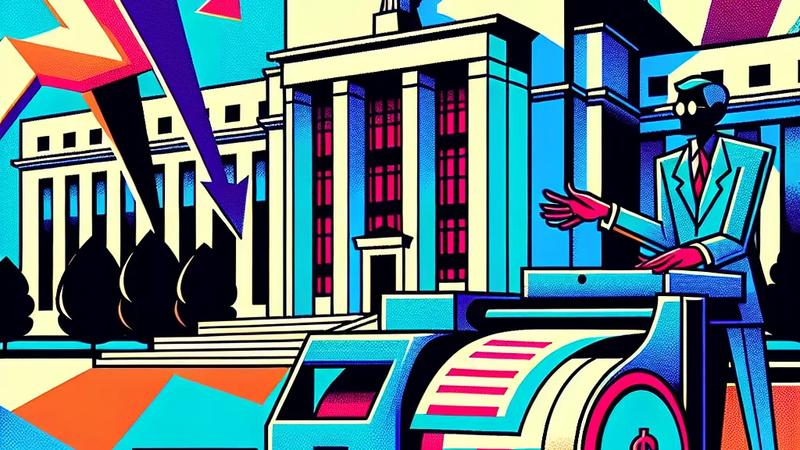
The United States Federal Reserve is poised to embark on a new phase of gradual money printing that will gently influence asset prices, without the intensity that some Bitcoin enthusiasts anticipated, according to economist and Bitcoin advocate Lyn Alden. Alden suggests that this approach, while not as aggressive as previous expansions, will still lead to currency debasement over time.
In her investment strategy newsletter dated February 8, Alden indicated her expectations align with the Federal Reserve's plans to expand its balance sheet at a pace that matches the growth of total bank assets or the nominal gross domestic product (GDP). She elaborated, 'Overall, I remain inclined to invest in high-quality, scarce assets, while strategically reallocating from overheated markets to those that are underappreciated.'
The Federal Reserve's M2 money supply metric continues its gradual expansion, reflecting this ongoing monetary strategy. This comes in the wake of President Donald Trump's nomination of Kevin Warsh for the position of the next Federal Reserve Chairman. Warsh is perceived by market participants as having a more hawkish stance on interest rates compared to other candidates, creating a stir among traders.
Interest rate policies significantly impact cryptocurrency prices. Generally, an increase in money supply is seen as positive for asset valuations, whereas tightening through elevated interest rates can result in economic slowdowns and declining prices.
Looking ahead to the next Federal Open Market Committee (FOMC) meeting in March, only 19.9% of traders expect a rate cut, a decrease from the 23% who anticipated such a move earlier this week, according to CME Group data.
Current Federal Reserve Chairman Jerome Powell has offered varied indications regarding future interest rate decisions, despite having reduced rates on multiple occasions in 2025. He noted, 'Short-term risks to inflation lean upwards, while employment risks are downwards, presenting a challenging environment with no risk-free policy path,' after the December FOMC meeting.
Powell's term concludes in May 2025, and Warsh's confirmation by the US Senate remains pending, adding to investor uncertainty around future interest rate directions in 2026.
As the financial community keenly observes these developments, the influence on both traditional and digital assets continues to be a topic of significant interest.